
Audemars Piguet. When gold becomes sculpture

Updated: 3 hours ago

In 1972, an Audemars Piguet brochure pictured a
woman smoking a cigar. On her wrist was Arabella, a spectacular high jewellery watch. That same year, the house launched the Royal Oak. The image deserves a second look: as the watch that would come to define the brand was born, Audemars Piguet was putting a very different iea of luxury on display.
That diversity was real. Between 1972 and 1976, the Royal Oak never accounted for more than 7% of the watches produced by the house. Around it lay a whole world of tiny mechanisms, gold bracelets and coloured stones. Recent creations offer a fresh perspective on just how much that world contributed.
THE MAKING OF A JEWEL
Making time fit inside a jewel

Founded in Le Brassus in 1875, Audemars Piguet worked within the tradition of etablissage: a network of specialists contributed to the different parts of a watch.
The mechanisms came from the Vallée de Joux; their cases and bracelets could take shape elsewhere, in the hands of jewellers.
In 1921, a movement sent to New York received a setting by Oscar Heyman. The result was a secret bracelet watch, its dial hidden beneath a precious cover. In 1929, the Tutti Frutti, cased by the Parisian firm Egouvillon Lafon & Cie, brought rubies, sapphires, emeralds and diamonds together around a tiny AP calibre.
Miniaturisation gave designers room to expe
riment. That freedom then extended to the bracelet. From the 1950s, gold bracelets became increasingly common on men's watches too. In the decades that followed,
they grew so prominent that the case sometimes.
seemed to disappear into their design.

1921. Calibre 8RP, no 28594, similaire au no 25525. Collection Audemars Piguet

Circa 1922. High jewellery wristwatch n° 104841. Audemars Piguet collection, inv. 1666. Oscar Heyman.
GOLD IN MOTION
The bracelet becomes the watch
Audemars Piguet’s sculptural bracelets grew out of a network of independent chainmakers and jewellers. In the 1960s, the house worked with Italian firms including Masella, Antonioli and Villa, Parisian makers Cristofol and Georges Lenfant, and Geneva artisan Jean-Pierre Ecoffey. Their gold and platinum bracelets were then adjusted, finished and fitted to their cases in Le Brassus.
Each workshop contributed specialist skills: weaving fine mesh, assembling geometric links or creating richly textured surfaces. The resulting watches owe their character as much to this craftsmanship as to their design.

Circa 1965–1975. Audemars Piguet models. Models 8512, 8622 and 8554

Circa 1965–1975. Audemars Piguet models. Models 8067, 8157 and 819

Within this broader tradition, the 5403, introduced in 1971 and designed by Gérald Genta, offers a striking example: ten thick Polish-mesh links gradually widen to embrace the dial. Its
seamless silhouette belongs to a much larger story of collaboration between designers, bracelet makers and Audemars Piguet’s own craftspeople.
Texture can then transform the surface. Pressing the woven bracelet with a die can alter its appearance until the weave almost disappears. Engraving can carry a continuous decoration from case to bracelet. Different techniques produce that impression of a watch made in one flowing piece.
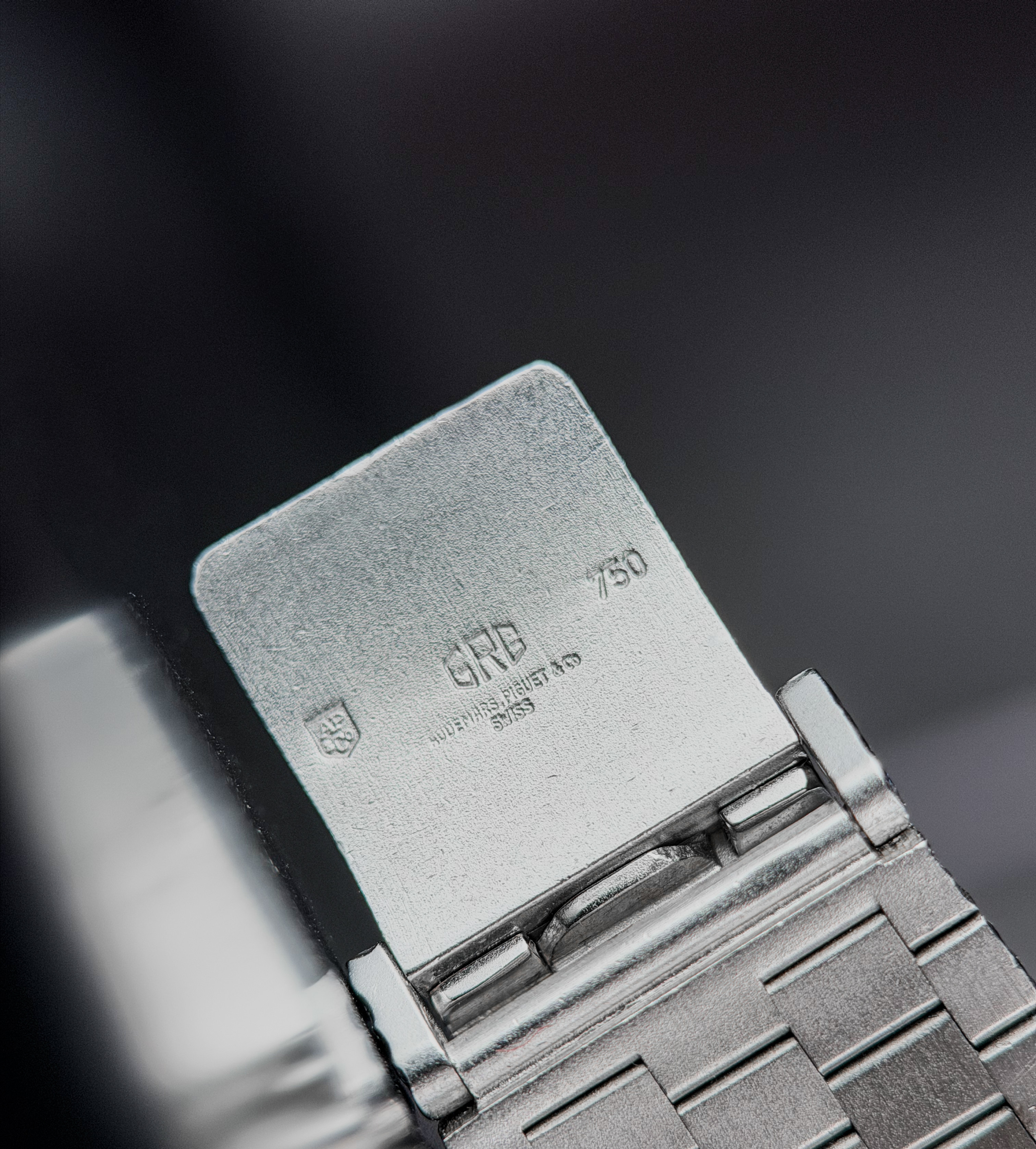
These watches also reveal less familiar signatures. On some bracelets, the letters GRG identify Roland-Gilbert Gaschen. The maker's name is tucked behind the clasp; his work occupies almost the entire watch.

Audemars Piguet Cobra - Onyx and Diamonds Hands, Roland-Gilbert Gaschen bracelet. Cyclope Watches
Audemars Piguet Cobra - Onyx and Diamonds Hands, Roland-Gilbert Gaschen bracelet. Cyclope Watches
COBRA IN FOCUS
The many faces of the Cobra
The Cobra takes its nickname from its silhouette: a supple gold bracelet with a scale-like texture that widens around the dial, recalling the flared hood of a raised cobra. Adopted by collectors, the name does not refer to an officially named Audemars Piguet collection. Instead, it brings together several references sharing this seamless relationship between case and bracelet.
To understand its origins, we must return to reference 5403, introduced in 1971. Designed by Gérald Genta, it combines a round dial with a bracelet composed of ten broad, thick Polish-mesh links that gradually widen to embrace it. Its ultra-thin automatic calibre 2121 preserves a remarkably slender profile despite the generous gold construction.

Audemars Piguet Cobra 5403

Calibres 2120 and 2121, caseback side. Extra-thin selfwinding calibres. Diameter of 28 mm (12½ lignes). The aesthetic on the caseback side is similar for Calibre 2120 (between 1967 and 2006) and Calibre 2121 (between 1970 and circa 2011). Movement 127053 produced in 1970. Audemars Piguet Heritage, inv. 365

1971. Articulation between bracelet and case 5402. At its extremities, the case middle forms a 43° angle to open onto the bracelet. Two holes enable to screw the first studs. Detailed plan. Audemars Piguet Archives.
The bracelet’s depth comes from its structure. Polish mesh alternates right- and left-handed wire spirals joined by fine pins, creating a symmetrical weave with pronounced relief. Milanese mesh, by comparison, interlaces the spirals to form a characteristic diagonal pattern. On the Cobra, the definition of the weave must continue through the transition into the case: soldering and polishing require great precision to preserve this sense of continuity and volume.
Reference 5587 carries this broad integrated-bracelet aesthetic into a day-date configuration. A white-gold example documented as sold in 1985 features a deep blue dial with two contrasting subsidiary displays at three and nine o’clock. The bracelet remains the dominant feature, while this calendar layout immediately distinguishes it from the 5403 with its single date window.

Cobras also exist in more compact formats, with cushion-shaped cases and manually wound movements. Reference 14579BC provides one example: a documented piece from 1993 measures 26.5 × 32 mm and pairs white gold with a navy-blue dial and diamond hour markers. These watches, however, are not simply scaled-down versions of the larger model. Their bracelets come in several executions that noticeably change their character.
Some feature small, rounded elements resembling grains of rice, repeated to form a supple, finely articulated surface. Others use more geometric elements arranged in staggered rows like miniature bricks. Examples catalogued under reference 14579BC illustrate this latter execution.
Other compact versions feature a substantial Polish weave in the spirit of the original Cobra bracelets. The mesh is thicker, the relief deeper and the quantity of gold greater. One example handled by Cyclope under the name “Heavy Cobra” illustrates this combination: despite its case measuring approximately 27 × 32 mm, its substantial bracelet brings the watch’s total weight to around 104/122 grams. Here, “Heavy” describes this particularly generous construction within a compact format.
Finishing introduces further variations: polished surfaces, finely striated elements, rounded contours and contrasting textures change the way the gold catches the light. The bracelet’s pattern, thickness and transition into the case give each version its particular proportions and presence on the wrist.
The variations extend beyond the bracelet. Audemars Piguet also explores colour and material through its dials, including Cobra examples in onyx and lapis lazuli. The richness of the weave meets the depth of the stone, another way of composing the jewellery watch, which we explore in the following section.
STONE AND LIGHT
Colour takes work too
Long before the colourful dials of the 1960s, stones already had a place in watchmaking. Their use, however, remained exceptional for many years. Turning stone into a wristwatch dial meant overcoming several challenges: finding sufficiently sound material, cutting it into an extremely thin slice, then drilling and securing it without breaking it. The beauty of the stone alone was not enough; craftspeople also needed the means to work it on this scale.
In the 1960s, growing demand for colourful dials encouraged further experimentation. In Idar-Oberstein, Germany, lapidaries developed techniques for cutting stones into very thin slices. Geneva dial maker Stern adapted this expertise, securing a layer of stone approximately 0.5 mm thick to a thin metal backing. This construction opened new possibilities for watchmakers. Piaget introduced stone dials into its collections in 1963, Vacheron Constantin in 1965, followed by Audemars Piguet in 1968.

The work remained delicate. A date window or applied hour markers required holes to be drilled into material that could fracture at the slightest mistake. Diamond powder, water and a precise hand made it possible to work these fragile surfaces, whose natural inclusions contributed as much to their beauty as to their vulnerability.

Onyx, lapis lazuli and tiger’s eye represent only part of this repertoire. Audemars Piguet’s creations also explored malachite, azurmalachite, opal, jasper, amethyst, grossular garnet and ruby. Some stones offer an almost uniform colour; others reveal veins, bands, inclusions or shifting reflections. Each slice produces a different dial. This diversity runs through the house’s jewellery watches, extending well beyond the Cobra.
Other materials further enrich the palette: mother-of-pearl, coral and aventurine glass, often grouped with stone dials despite their different origins. Their reflections and textures multiply the possibilities for combining colour with gold and diamonds.

Jewellery craftsmanship also extended to the hands. Setting them with gemstones posed a particular challenge: they had to remain sufficiently fine and light to perform their function. This longstanding craft gained fresh momentum when Italian jeweller Luigi Stumpo developed a new technique, for which Audemars Piguet signed an exclusive agreement in 1969. According to an account published by Christie’s, an antique watch he discovered at the museum of Geneva’s watchmaking school inspired him to recapture that finesse. He then developed the tools needed to achieve it.
THE BAMBOO
When Design Extends Beyond the Watch
After the Cobra’s woven bracelets and the colours of stone dials, the Bamboo opens another chapter: a motif that connects case and bracelet, then extends into jewellery and accessories. Here, goldwork gives rise to an entire vocabulary of shapes.
Its story begins with a drawing. According to Sebastian Vivas, Director of Audemars Piguet’s Museum and Heritage, the earliest known sketch is signed by Jacqueline Dimier and dated 24 January 1982. Presented at the Basel Fair in 1984, the Bamboo was conceived as a collection in its own right. Two years later, it already comprised 37 references.
This variety grew around an immediately recognisable idea: rounded elements recalling bamboo stems, articulated to follow the wrist and carried through into the bezel. The design could remain understated, become covered in diamonds or incorporate contrasting materials. In 1986, the Bamboo introduced ceramic at Audemars Piguet: black elements punctuated the gold, giving its volumes a different visual rhythm.
The archives reveal a less familiar continuation of the story. The Bamboo also inspired designs for rings, pens and key rings. Its distinctive forms remained recognisable even without a movement inside: a watch had become the starting point for a wider family of objects.
These projects belonged to a design studio where experimentation played a central role. Emmanuel Gueit, who joined Jacqueline Dimier in 1987, recalled producing several gouache drawings each day. The designs were then presented to Steven Urquhart, who worked with the designers to decide which would become prototypes or small production runs. Their scope extended from watches to jewellery, from bags to belts, and even to a high-jewellery chess set.
His recollections describe the creative atmosphere of the period rather than the Bamboo’s initial development. They help explain how one house could explore such a variety of forms: each design opened up the possibility of another object.

The Bamboo collection inspired numerous designs for accessories and jewellery after its launch in 1984. Gouache AP.A.68. AP Archives Keyring 7256058. Inv. 5778; ring 073, Inv. 5154; pen 56058, Inv. 5777

Audemars Piguet Bamboo Rivière, reference BA.56214.636, 457 diamonds bracelet, pave diamond dial (296 diamonds),(Cyclope's collection

Audemars Piguet Bamboo, reference 56206CA, Monaca Legend
A CONTINUING CONVERSATION
Arabella keeps giving us ideas
These skills continued to run through the collections. In 2017, a Millenary once again featured a Polish-mesh bracelet. The collaboration with Carolina Bucci explored gold hammering through the Frosted Gold finish.

In 2026, the Atelier des Établisseurs made this collective history especially visible.
To design Galets, Xavier Perrenoud drew inspiration from the shores of the Lac de Joux and from the Arabella of the 1970s. Every link has a different shape. Jeweller Nadia Morgenthaler had to find a way to articulate those irregular elements: after several trials, she chose tiny ball joints. Mario Senape selected and cut the stones.
This is where the connection with vintage watches becomes compelling. A free-flowing shape raises a very practical question: how do you make it hold together, move and live on a wrist? The answer still calls for a designer, a jeweller, a lapidary and watchmakers.
More than half a century after the brochure with the cigar,
Arabella has inspired a new watch. The thread between
them runs through the workshops.
By Cyclope.
Comments